
The first quarter of 2026 tested investor confidence as geopolitical conflict, higher oil prices, and renewed inflation concerns weighed on markets. But beneath the headline decline, sector leadership broadened, energy surged, and the quarter reinforced the enduring value of diversification, patience, and disciplined decision-making.
The beginning weeks of 2026 started positively for investors. Investor enthusiasm was high, inflation appeared steady, and the year ahead looked promising. After a strong run for U.S. equities—particularly large-cap technology and artificial intelligence-related stocks—many investors entered the new year with confidence that markets could continue to climb.
That confidence was tested quickly.
The February 28, 2026, U.S.-Israel military attacks on Iran triggered immediate global market volatility, characterized by a sharp sell-off in equities, pressure on airlines and other economically sensitive stocks, and a surge in oil prices amid threats to the Strait of Hormuz. According to the International Relations Review, the S&P 500 dropped approximately 7% in the aftermath, while Brent crude oil breached $100 per barrel.
Events like the ongoing conflict in Iran are unsettling, and investors often worry how such wars may impact their portfolios. When will financial markets recover? History shows we’ve faced similar situations. It’s important to recall that markets anticipate future outcomes; prices react swiftly to new information. If news is negative for investors, values frequently decline. However, markets are fundamentally set with positive expectations for returns.
Past stock performance reinforces this idea. Even during periods of economic and political turmoil, global equity markets have generally moved upward. Numerous examples demonstrate that, over recent decades, stock markets stayed resilient and delivered gains despite various geopolitical tensions worldwide. (See Chart below)
Markets Have Rewarded Discipline
Growth of $1—MSCI World Index (net dividends), 1970-2025
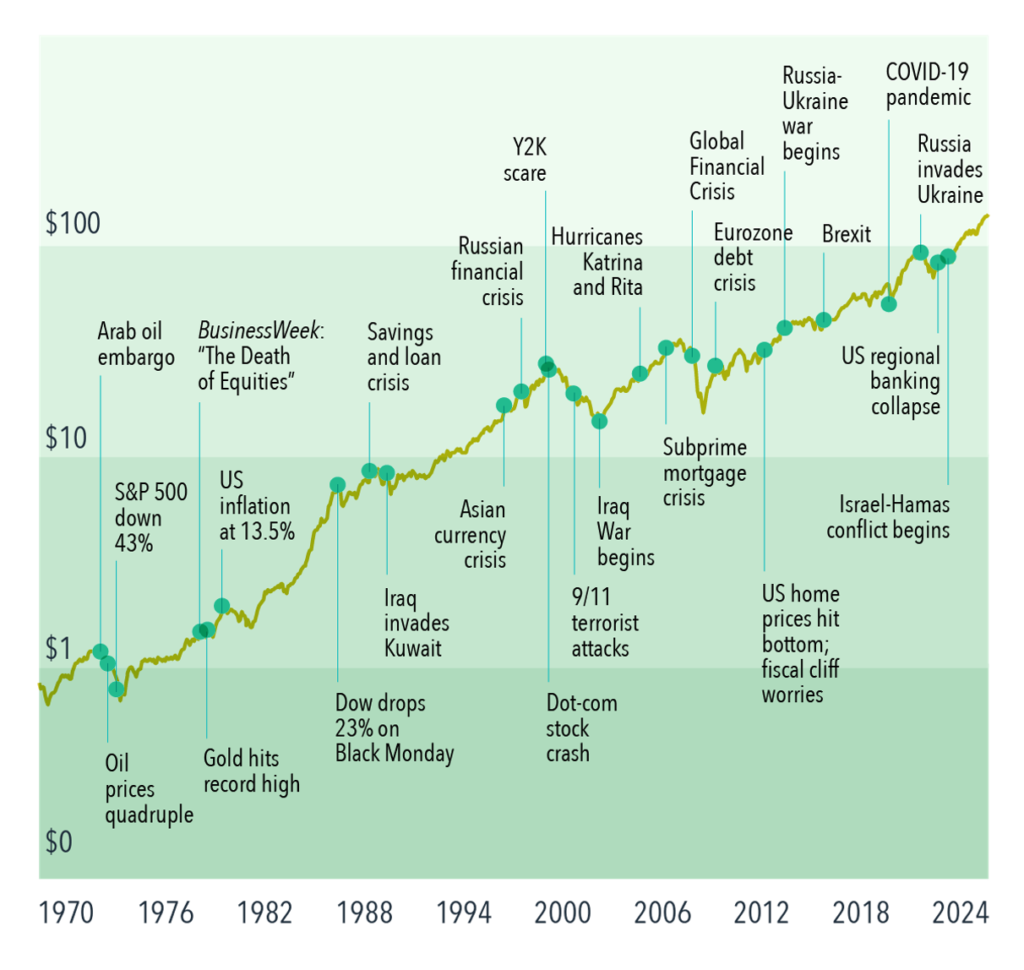
Past performance is not a guarantee of future results. Actual investment returns may be lower. (Source)
How the Markets Reacted
The market reaction reflected several concerns at once: the possibility of a wider Middle East conflict, the potential for energy supply disruptions, the risk that higher oil prices could push inflation higher, and the possibility that the Federal Reserve would need to keep interest rates elevated for longer than investors had hoped.
Immediate impact highlights included:
- Equities and volatility: Global stock markets experienced significant declines, with the Dow Jones Industrial Average down around 7% and volatility rising sharply.
- Energy prices: Brent crude surged, with reports of an 8% jump within two trading days, driven by fears of supply disruption.
- Safe-haven assets: Gold and the U.S. dollar gained immediately following the attack as investors sought safety.
- Sector impacts: Airlines fell by more than 5%, while defense stocks saw initial fluctuations.
Now, some two months into the conflict, markets have generally rebounded. But the first quarter still offered several important lessons for investors, particularly those with diversified portfolios and long-term planning goals.
A few themes emerged in Q1:
- The broad stock market fell in the first quarter, but the overall decline masked gains in select sectors.
- Losses were led by technology and communication services stocks, which have heavy weightings in major market indexes.
- Investors rotated into stocks that had been lagging in recent years, including value stocks, small-cap stocks, dividend payers, and energy companies.
In short, Q1 2026 was volatile. U.S. equities were generally negative, and international markets held up somewhat better on a relative basis, though both were hit by a late-quarter risk-off move tied to geopolitical shocks and rising inflation concerns.
While the stock market began the year with losses, some sectors actually gained as investors moved away from recent winners. Despite uncertainty from the Iran war and concerns that artificial intelligence enthusiasm had pushed some valuations too high, basic materials, industrials, consumer defensive companies, and especially energy stocks rose. Energy was fueled by higher oil prices and renewed concerns over supply.
Many of the mega-cap growth stocks that had been riding the AI boom suffered losses during the quarter. That included some of the biggest names in the market. Microsoft declined 23.3%, while Nvidia fell 6.5%, according to Morningstar. Because these companies carry significant weight in major indexes, their losses were a key driver of the overall market decline. The Morningstar US Market Index fell 4.2% during the quarter.
What Drove Performance
The main influence on the market in Q1 was the conflict in the Middle East and the resulting oil shock. Rising tensions between the U.S., Israel, and Iran led to crude prices jumping above $100 per barrel and sparked worries that elevated energy costs would keep inflation high.
The Strait of Hormuz, previously unfamiliar to many Americans, became a focal point for market stress during this period. Since it is a vital route for global energy transport, any risk to supply can quickly affect energy markets, consumer prices, company profits, and how investors feel about the market.
Another key factor: shifting expectations about Federal Reserve policy. As inflation risks grew, markets abandoned the idea of imminent rate cuts, putting pressure on stocks and bonds. On April 29, 2026, the Fed kept rates at 3.5%-3.75% for the third straight meeting to address persistent inflation—now worsened by rising energy costs from Middle East conflict—and slower job growth.
The Fed adopted a cautious approach, balancing ongoing inflation with a sluggish labor market. Investors are closely watching data on inflation, jobs, oil prices, and spending. Markets began 2026 expecting lower rates, but the oil shock delayed cuts; this especially impacted growth stocks dependent on future earnings. As a result, mega-cap tech stocks saw declines, with investors rotating into previously less popular sectors.
Market Rotation
Q1 saw a shift in market leadership, not just a decline. Technology and communication services, previously strong performers, faced challenges from high valuations, profit-taking, uncertainty around interest rates, and concerns over AI-driven stock surges. Meanwhile, investors favored value stocks, dividend payers, small caps, and defensive sectors like materials, industrials, consumer defensives, and energy.
Such rotations occur when investors reassess risk. Concentrated leadership can make portfolios vulnerable, as broad indexes depend heavily on a few large companies. Diversification is crucial since sectors and asset classes react differently to market changes. Q1 showed that former laggards can emerge as new leaders.
The Energy Sector
Let’s take a closer look at energy.
The energy sector is one of the 11 major investing sectors and is generally a component of most diversified portfolios. It is not simply represented by how we heat our homes or fuel our cars. The sector includes companies involved in producing, refining, transporting, and supplying energy, including fossil fuels such as oil, gas, and coal, as well as renewable sources such as solar and wind.
Energy is a cyclical, commodity-driven sector. It includes exploration and production companies, pipeline and infrastructure firms, refiners, integrated oil companies, and utility-related businesses. Analysts often break the sector into three categories: upstream, midstream, and downstream operations.
Energy surged in Q1 2026 because the quarter combined a sharp oil-price spike, tight supply conditions, strong refining margins, and a geopolitical bid for hard assets. Morningstar reported that energy led the market with a 38.1% gain on the back of the “oil price leap.” Other market recaps pointed to tight global supply, strong refining margins, and persistent geopolitical risk as factors that kept crude prices elevated and cash flows strong.
According to Morningstar, the main drivers of energy’s rally included:
- Middle East conflict: The Iran war and broader Middle East tensions pushed investors toward energy equities as crude prices rose and supply risks increased.
- Oil shock: Higher crude prices improved revenue and margin expectations, especially for integrated majors, refiners, and midstream companies.
- Valuation rebound: Energy entered 2026 with relatively depressed valuations after years of underperformance, giving the sector more room to recover than crowded growth sectors.
- Inflation-hedge behavior: As inflation fears resurfaced, investors favored commodities and cash-flow-heavy energy companies over more rate-sensitive growth stocks.
Energy’s strong quarter does not mean investors should simply chase the sector after a sharp rally. Commodity-driven investments can be volatile. Oil prices can rise quickly, but they can also fall quickly if supply concerns ease, demand weakens, or geopolitical risks recede.
Still, the quarter showed why energy can play an important role in a diversified portfolio. When inflation concerns rise and geopolitical risk increases, energy companies may behave differently from traditional growth stocks or interest-rate-sensitive assets.
Still a Cause for Concern
The resolution of tensions with Iran and the Strait of Hormuz is still unknown, and any major conflict could affect the global economy for years. However, geopolitical conflicts do not always lead to poor stock returns; markets are forward-looking and quickly price in negative news. Dimensional Fund Advisors analyzed 21 events since 1990 and found that while returns were slightly negative shortly after these events, they averaged 14.6% one year later—higher than the rolling 12-month average of 12.4%. Despite occasional negative outcomes, history shows investors benefit by staying invested during periods of uncertainty. (See Chart)
HD: Average US Stock Market Returns Following Major Geopolitical Event, 1990-2025
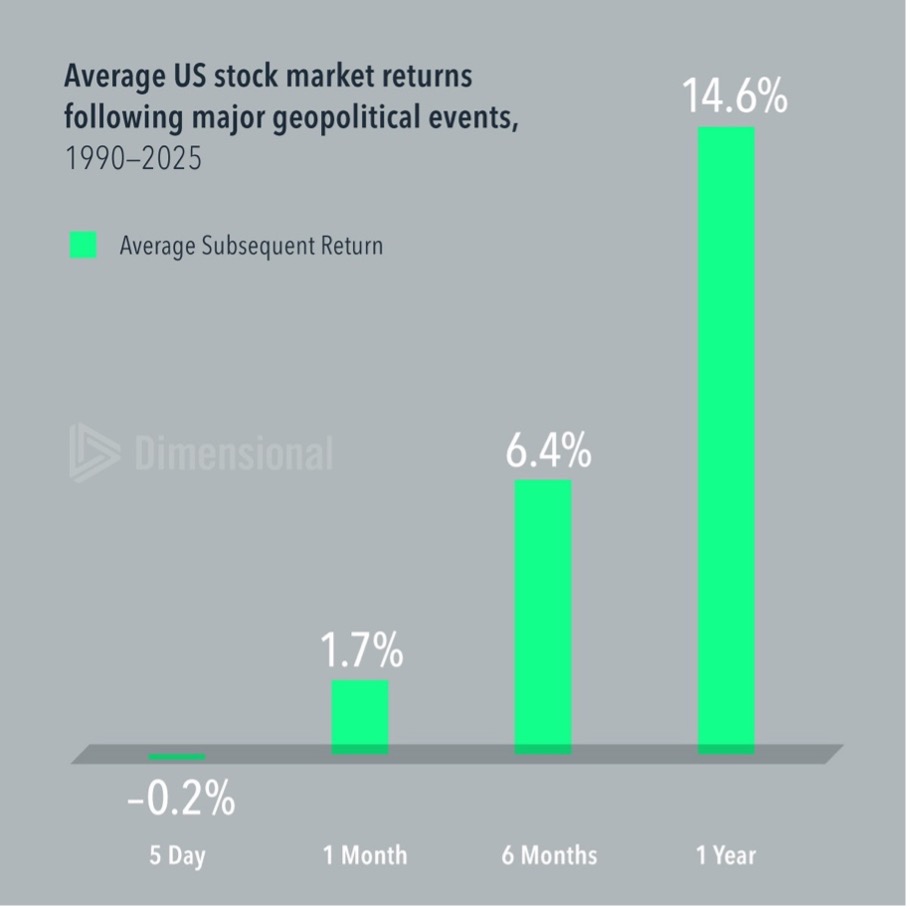
Past performance is not a guarantee of future results. Actual returns may be lower. In USD. US Market represented by the Fama/French Total US Market Research Index. The Fama/French indices represent academic concepts that may be used in portfolio construction and are not available for direct investment or for use as a benchmark. See “Index Descriptions” for descriptions of the Fama/French index data. Indices are not available for direct investment. Their performance does not reflect the expenses associated with the management of an actual portfolio. The chart is for illustrative purposes only and is not indicative of any investment. Sample includes 21 geopolitical events. Geopolitical events and their start dates include: Beginning of Gulf War, 08/02/1990; Asian Currency Crisis, 07/02/1997; Iraq Disarmament Crisis 1998, 02/18/1998; Russian Financial Crisis, 08/17/1998; Kosovo Bombings, 03/24/1999; 9/11 – World Trade Center Attack, 09/11/2001; Iraq War, 03/20/2003; Madrid Bombings, 03/11/2004; London Bombings, 07/07/2005; Iran Nuclear Tensions, 07/31/2006; Eurozone Debt Crisis, 12/08/2009; Arab Spring (Egypt), 01/25/2011; Libya Intervention, 03/19/2011; Ukraine Conflict 2014, 02/20/2014; Intervention in Syria, 09/22/2014; Paris Attacks, 11/13/2015; Brexit Vote, 06/23/2016; Airstrike on Syrian airbase, 04/07/2017; North Korea Nuclear Test, 09/03/2017; Russia Invades Ukraine, 02/21/2022; Israel-Hamas Conflict, 10/07/2023. Events are selected to include major armed conflicts and notable upheavals and are not inclusive of all possible market events.
What This Means for Investors
Q1 highlighted several takeaways:
- Diversification is crucial. While the overall market fell, certain sectors performed well; diversified portfolios help manage risk.
- Market leaders shift quickly. Recent dominance by tech and AI stocks gave way to value, dividends, small-caps, and energy.
- Index concentration can be risky. Index performance may hinge on a few large companies, increasing vulnerability.
- Geopolitical events cause short-term volatility. These shocks don’t guarantee poor long-term returns.
- Inflation and rates remain key. Rising energy prices could affect Fed actions and keep markets reactive to inflation.
- Discipline matters most during uncertainty. Assess risk before volatility strikes.
Looking Ahead
The first quarter of 2026 challenged investor confidence with geopolitical tensions, rising oil prices, inflation worries, delayed rate cuts, and tech sector weakness. However, it underscored the importance of diversification and discipline. Investors concentrated in recent winners saw shifting market leadership, while balanced portfolios benefited from exposure across sectors and asset classes during uncertainty. The future is unpredictable, but volatility is part of investing; the focus should be on building resilient portfolios.
As always, your Aurelius Family Office team is here to help you evaluate current market conditions in the context of your broader wealth plan, tax strategy, income needs, legacy goals, and long-term family objectives. Periods of uncertainty can be uncomfortable, but they can also be useful moments to reassess, rebalance, and reaffirm the strategy designed to help your family move forward with confidence.
Disclosures
Aurelius Family Office, LLC (“AFO”) is an SEC-registered investment adviser. Registration does not imply a certain level of skill or expertise. This communication is for informational purposes only and is not intended to provide specific investment, legal, tax, or other professional advice. Investments involve risk of loss. AFO is neither an attorney nor an accountant, and no portion of this content should be interpreted as legal, accounting or tax advice. For information regarding AFO’s services, fees, conflicts of interest, and related matters, please review our Form ADV at https://adviserinfo.sec.gov/firm/summary/323016. Visit us at https://aurelius-old.succeedingsmalldev.com/.