

Interest rates have climbed in 2026 because inflation remains elevated. The Fed raised its benchmark rate in September and held it on October 28, while mortgage rates top 7%.
For most households, the bigger question is where higher rates show up. Below is a quick look at who benefits, who feels the squeeze, and what to ask as you review your retirement income strategy.
Where Rates Stand
Rates have moved on two fronts: short-term rates set by the Federal Reserve and longer-term rates set by the bond market.
| Rate | Where it stands |
|---|---|
| Fed’s benchmark rate | 3.75% to 4.00%, raised in September and held on October 28, 2026 |
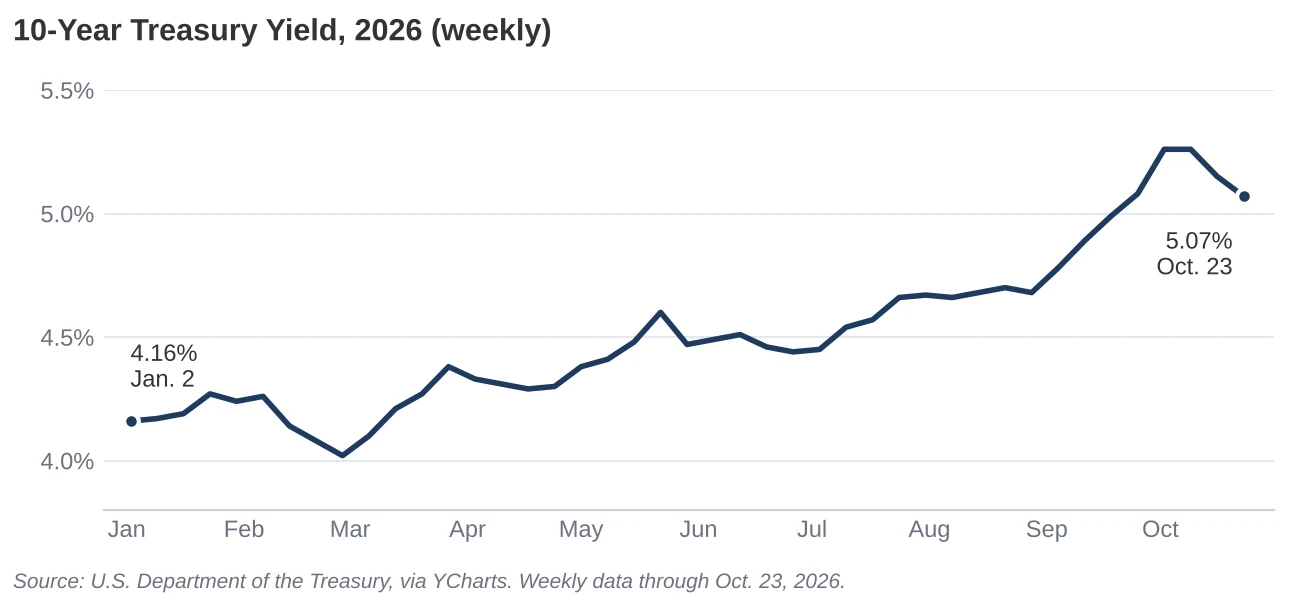
| 10-year Treasury yield | About 5%, up from about 4.2% at the start of 2026 |
| 30-year fixed mortgage | 7.24% average (Oct. 29, 2026), up from 6.17% a year earlier |
| Inflation | 3.7% over the past year (September), well above the Fed’s 2% target |
Sources: Federal Reserve, Freddie Mac, U.S. Bureau of Labor Statistics.
Two Fed officials voted for another increase in October, and the Fed said it will weigh incoming information before its next move. Higher borrowing costs may stick around for a while.
How Higher Rates Affect Your Finances
Higher rates help some parts of a household balance sheet and pressure others.
| Your finances | How higher rates tend to affect them | What to watch |
|---|---|---|
| Cash, money markets, short-term CDs | Yields rise within months of a Fed hike | Yields can fall quickly if the Fed cuts |
| Bonds and bond funds you own | Prices fall, longer-term bonds the most | Maturing bonds can be reinvested at higher yields |
| New annuity purchases | Payouts per dollar tend to rise | Fees, surrender charges and insurer strength |
| Stocks | Valuations face a higher bar | Whether company earnings keep pace |
| A fixed-rate mortgage you already have | Your payment doesn’t change | Higher costs if you move or downsize |
| Credit cards and other variable debt | Rates rise quickly | Balances relative to income |
| A new mortgage or home equity loan | Borrowing costs more | Whether the payment fits your budget |
For example, on a $400,000, 30-year mortgage, the rise from 6.17% to 7.24% adds about $285 a month to the principal-and-interest payment.
Diversifying Beyond Stocks and Bonds
Bonds have traditionally helped steady a portfolio when stocks fall. When inflation runs high, though, stocks and bonds can drop at the same time, as they did in 2022.
Some investors respond by adding alternative strategies, such as managed futures or market-neutral funds, that aim to behave differently from both. These can help diversify a portfolio, but they often come with higher fees, more complexity and their own risks, and past results don’t guarantee future returns.
Questions to Ask Your Advisor
Rising rates are a good prompt to make sure your plan still fits.
- Is my cash earning enough? Compare what savings, money market and short-term Treasury holdings pay after fees and taxes.
- How sensitive are my bonds to rate changes? Ask whether your bond holdings match when you’ll need the money.
- Do alternative strategies belong in my plan? Ask how they might fit your goals, what they cost and how they’re taxed, since some are better held in tax-advantaged accounts.
- Is it time to rebalance? Shifts in stock and bond prices can pull your mix off target. A disciplined rebalancing approach can help keep risk in check.
- Should I pay down variable-rate debt? Paying off a credit card charging around 20% is a guaranteed savings few investments can match.
- Do my withdrawal plans still work? Retirees may want to review how yields, inflation and market swings affect their income.
- What are the tax effects? Selling bonds, moving cash or rebalancing can all create tax consequences worth reviewing with proactive tax planning.
Building a Plan That Holds Up as Rates Change
No one can reliably predict where rates go next. A plan built around your income needs, taxes and time horizon can help you respond with intention instead of reacting to headlines.
If you’d like a second look at how today’s rates affect your portfolio or retirement income, connect with Aurelius Family Office to start the conversation.
Disclosures
Aurelius Family Office, LLC (“AFO”) is an SEC registered investment adviser. Registration with the SEC does not imply a certain level of skill or expertise. This communication is for informational purposes only, and is not intended to provide specific investment, legal, tax, or other professional advice. The case studies presented are designed to illustrate AFO’s approach to specific client situations. The client(s) for whom the case studies apply have not endorsed or otherwise provided testimonials for the firm or its staff. The case studies are based on specific client situations which may not apply to your particular situation. Please consult with an AFO professional for guidance. Information regarding AFO’s services, fees, conflicts of interest and related matters can be found by clicking the following link https://adviserinfo.sec.gov/firm/summary/323016 and viewing the latest Form ADV, Part 2 Brochure and Part 3 Relationship Summary. Please visit us at https://aurelius.net