

Trump accounts (officially known as 530A accounts) are new tax-deferred IRAs for children under 18. Babies born 2025 through 2028 can get a free $1,000 from the U.S. Treasury, and families can add up to $5,000 a year.
Here are the essentials, plus how to decide whether adding your own money makes sense.
The Basics
| Feature | What to know |
|---|---|
| Who qualifies | Children under 18 with a Social Security number |
| Free $1,000 | One time, for U.S. citizens born 2025 through 2028. You must claim it. |
| Yearly limit | $5,000 per child from family, friends and employers combined |
| Employer money | Up to $2,500 per employee, counted within the $5,000 |
| Investments | Low-cost U.S. stock index funds, such as S&P 500 funds |
| Access to money | Starting January 1 of the year the child turns 18 |
| Who holds it | Treasury’s partners, Bank of New York Mellon and Robinhood |
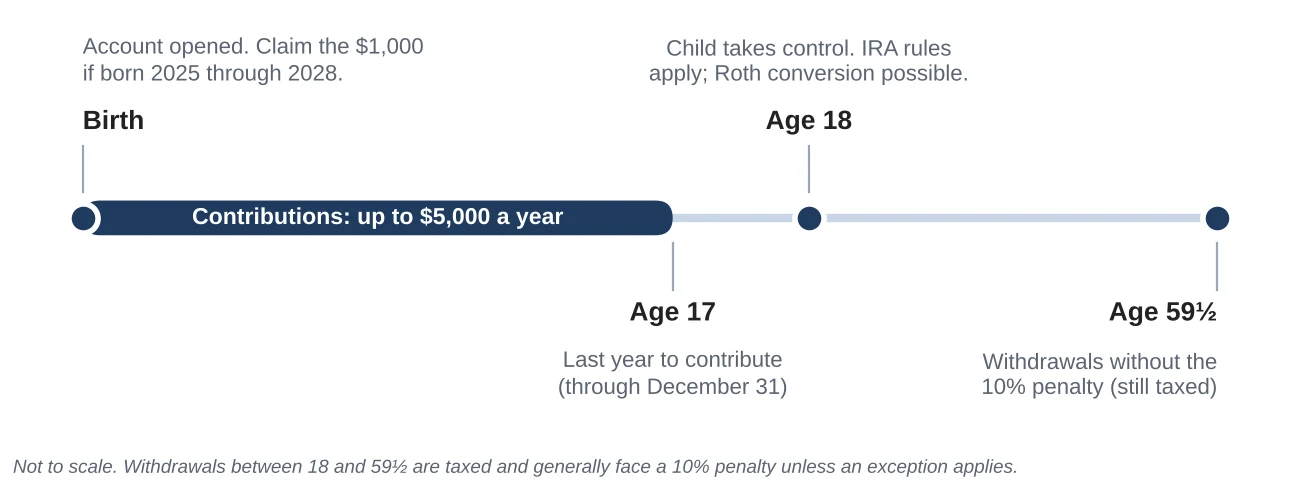
How a Trump Account Works Over Time
The account follows a child from birth to retirement, with different rules at each stage.
Baby Born 2025 to 2028? Claim the $1,000
Treasury has already opened accounts for most eligible children, but the $1,000 isn’t added until a parent or guardian claims it.
- Make sure your child has a Social Security number.
- Claim the account in the official Trump Accounts app or at trumpaccounts.gov.
- Make the $1,000 election online or on IRS Form 4547 with your tax return.
- Ask your employer whether it contributes for employees’ children.
Should You Add Your Own Money?
Claiming the free $1,000 is an easy yes. Adding your own dollars depends on what you want the money to do.
| It may make sense if… | Another option may fit better if… |
|---|---|
| You want to give a child a head start on retirement savings | You’re saving for college, since a 529 plan offers tax-free withdrawals for school |
| Your own retirement and college savings are on track | You’re still building your own retirement savings |
| You’re comfortable with your child controlling the account at 18 | You want more say over how and when the money is used |
Bonus: Once your child has a job, they can also contribute to a Roth IRA. The two limits are separate.
Taxes in Brief
- No upfront deduction: Family contributions aren’t deductible, but investments grow tax-deferred.
- Taxed when withdrawn: Earnings, plus money from the government or an employer, are taxed as ordinary income.
- 10% penalty before 59½: Most early withdrawals face a penalty, with exceptions such as college costs or up to $10,000 for a first home.
- Roth conversion option: After 18, the account can be converted to a Roth IRA. Taxes are due at conversion, but future qualified withdrawals can be tax-free. The kiddie tax can affect timing, so plan it with a tax professional.
Good to Know
- Rules are still being written: Treasury’s current regulations are temporary or proposed, so details may change.
- Aurelius can’t manage these accounts: For now, only Treasury’s partners hold them. We can still help you decide how one fits your plan.
- Don’t let the name decide for you: Regardless of the name, these accounts follow the same kind of tax rules as other savings accounts, so it’s worth judging them on how they fit your goals. Many Roth IRA owners don’t know the accounts are named for William Roth, the longtime Delaware senator who championed them.
The Bottom Line
For most families with an eligible baby, claiming the account and the $1,000 is a simple win. With the Roth conversion option, adding your own money may make sense if your goal is to give your child a head start on retirement savings.
To see how a Trump account fits with your 529 plans, gifting and retirement, talk with an advisor at Aurelius Family Office.
Disclosures
Aurelius Family Office, LLC (“AFO”) is an SEC registered investment adviser. Registration with the SEC does not imply a certain level of skill or expertise. This communication is for informational purposes only, and is not intended to provide specific investment, legal, tax, or other professional advice. The case studies presented are designed to illustrate AFO’s approach to specific client situations. The client(s) for whom the case studies apply have not endorsed or otherwise provided testimonials for the firm or its staff. The case studies are based on specific client situations which may not apply to your particular situation. Please consult with an AFO professional for guidance. Information regarding AFO’s services, fees, conflicts of interest and related matters can be found by clicking the following link https://adviserinfo.sec.gov/firm/summary/323016 and viewing the latest Form ADV, Part 2 Brochure and Part 3 Relationship Summary. Please visit us at https://aurelius.net